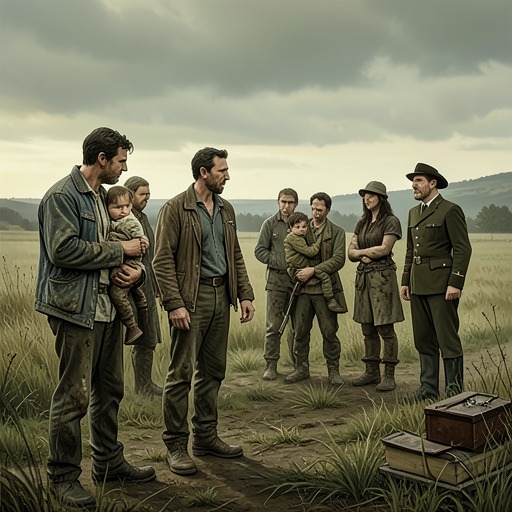
Emilio
East of the MountainsEmilio is a migrant worker traveling alone in search of apple-picking work, and one of the people through whom Ben Givens’s journey turns outward toward others. Ben first meets him as a silent, stranded young man with battered belongings; later, Emilio brings firewood to Ben and wakes him to help a woman in labor. His importance lies in that movement from need to care: Emilio arrives seeking help, but becomes the person who calls on Ben to serve someone else.
Identity and Arrival
Emilio appears in Wenatchee after an ambulance has carried away Angel and Angel’s brother, leaving another boy in the bus-station loading bay. The boy waits with plastic bags and does not look at Ben. Their first exchange establishes an immediate barrier: Ben’s Spanish is minimal, and the boy speaks no English. Emilio identifies himself by a single name. He is not related to the two other boys who had traveled with him; he had met them while picking pears near Yakima, and they had told him about apple work farther north. When they leave, he remains, still intent on finding work in Orondo or elsewhere.
His few possessions and worn clothing make the distance he has traveled visible. Ben notices battered black shoes coming apart at the welts, tattered plastic bags, and a body dusty and sun-beaten. Ben imagines that Emilio may have covered a thousand miles, sleeping under trees and bridges, but this is Ben’s conjecture, not a history Emilio relates. The distinction matters: Emilio’s circumstances are plain, but much of his past remains beyond what the two men can communicate. He says that he has no friends there and is alone. The novel offers that isolation without supplying a complete account of its causes.
Work and the Orchard World
Emilio’s search for employment places him within the seasonal labor of the apple country. He has already picked pears near Yakima and wants to harvest apples; when Ben consults a Spanish-language guide and dictionary, he checks the word for harvesting and asks whether apples are the work Emilio wants. Emilio confirms it. The exchange is halting, but its purpose is clear: Ben is trying to understand a practical need, and Emilio is trying to find a place where that need can be met.
The surrounding landscape is shaped by labor rather than by an untouched pastoral ideal. At harvest, workers climb ladders, fill bags, and ease apples into bins to avoid bruising them; tractors move the loaded bins to sidings, where forklifts load trucks. Pickers rest in small groups, while children sprawl in the grass and dogs lie among the rows. Coats, hats, canteens, and bottles hang or lean among the branches. The harvest makes the orchards audible with workers’ voices and visible through the steady removal of fruit. Emilio’s wish to join this work connects his search to a larger, recurring agricultural season.
That labor also has a history in Ben’s own life. The Givens family planted orchards beside the Columbia River, and Ben grew up making boxes, tending gardens, milking cows, clearing irrigation ditches, and caring for fruit trees through the seasons. His experience gives him a bodily familiarity with orchard work, but it does not erase the difference between his rooted family history and Emilio’s unsettled search for a job. The contrast lets the novel place agricultural abundance beside the effort and uncertainty required to harvest it.
Communication and Mutual Recognition
Because words fail, Ben and Emilio build their first connection through attempts at translation and concrete offers. Ben buys Spanish for Travelers and an English-Spanish dictionary at a bookstore, then sits with Emilio on the sidewalk to work through the vocabulary. Later, at a mostly empty restaurant on Wenatchee Avenue, Ben orders tea for himself and a T-bone steak with fried potatoes for Emilio. Emilio eats neatly and unhurriedly, using his knife deftly; white scratches mark the backs of his hands, and his fingers are thick, callused, and cracked around the nails. The meal gives their conversation time, but it does not turn Emilio’s life into an easily told story.
Ben asks no more questions as the language falters. He wonders about Emilio’s family, how he became separated from anyone close to him, and what kind of life he left behind, but recognizes that these questions cannot be answered simply by finding the right words in a travel dictionary. The scene gives Emilio a reserve that is not the same as emptiness: his story exceeds what Ben can learn at the table. Their companionship begins instead with what can be understood—work, hunger, and loneliness. When Emilio says he is alone, Ben answers that he is too, establishing a point of recognition without claiming that their lives are the same.
Care at the Cabin
At the Wolfhound Orchard, Emilio’s role changes from job seeker to caretaker. He comes to Ben’s cabin carrying stove wood, explains that it is very cold, and sets the wood down. He places Ben’s rucksack on the room’s only chair, covers Ben’s legs with a blanket, and builds a warming fire. These are quiet, practical gestures, offered without a long explanation. Ben thanks him as the fire catches. Their earlier exchange about work and food has become a more intimate form of help: Emilio notices Ben’s discomfort and acts on it.
Later, Emilio kneels beside Ben and repeatedly calls him señor until he wakes. He tells Ben that a doctor is urgently needed. The field boss, Sanchez, explains that a woman in the camp is in labor and that the baby is stuck. Ben agrees to go with them. Emilio leads the way through the pines, into an orchard where dark apples remain unpicked, and onward toward a dusty field of trailer homes. Pickers stand in the cold; dogs wander, and children run through the camp. Emilio presses on toward the trailer where the woman is waiting. The evidence establishes his urgency in bringing Ben there, not the outcome of the birth.
Narrative Role
Emilio’s scenes turn the novel’s attention from Ben’s private crisis toward needs that are immediate and shared. He first appears as someone who needs food, work, and company; later, he becomes the messenger whose actions bring Ben to a medical emergency. That reversal does not make Emilio a mere instrument for Ben’s development. His own need for employment, his separation from the boys he had traveled with, his silence about his past, and his careful acts of hospitality remain distinct parts of his portrayal.
The language barrier shapes the relationship without wholly preventing it. Ben struggles through dictionaries and imperfect Spanish; Emilio communicates through a few words, gestures, and the purposeful work of carrying wood and leading the way. What passes between them is not a complete explanation of either man’s life, but a limited and consequential recognition. Emilio’s presence connects the harvest’s abundance to the people who labor within it, and his care helps make Ben’s medical identity active again: when the camp asks for a doctor, Ben goes.